

Use the free Spotify playlist generator to make a mix from artists, songs, genres, or playlists you already enjoy. Choose a length, refine the results, then edit and save your new playlist.
Quickstart: Make Your First Playlist
- Open the generator and enter a name. Choose a track count or a duration.
- Under Sources, add an artist, track, genre, or playlist. Connect your Spotify account when prompted.
- Start with broad Track Features ranges, then choose Generate.
- Review the draft in the editor. Rearrange or remove tracks, then use the File Menu to add the playlist to your library.
For example, start with an artist you enjoy and a target of 25 tracks. Leave feature ranges broad for your first run, then narrow Energy or Tempo if the mix needs a different feel.
For a ready-made starting point, browse the homepage's playlist presets. Each selects sources and track-feature settings you can change. Loading a preset does not generate or save a playlist.
Once the playlist is generated you'll be sent to the editor to further refine your playlist. The playlist management guide explains the save options.
Choose sources and refine your mix
MixMoose uses your sources and track-feature settings to request recommendations, then applies options such as release years and exclusions. Available results depend on the sources and restrictions you choose.
Initial Parameters
- Playlist Name -Your playlist needs a name. One will be given to you initially, and you can press the "reroll" button to generate alternatives.
- Length -The length of your generated playlist can be expressed either as a number of tracks or a target duration.
Advanced Options
Expand Advanced Options to set the filters below. When collapsed, the header shows how many advanced settings are active. Collapsing the panel keeps your settings.
- Restrict years - After the Spotify Recommendation's service returns recommendations, those items are further filtered so that only tracks whose release dates fit within the range will be used. If only one date is given, then all tracks must fall within that year.
- Exclude Aberrant Tracks - Attempt to exclude tracks with phrases in their title that indicate they are strange versions. This might include tracks that are part of DJ mixes which will typically be cut off or have transitions to other songs. Other types of tracks that are removed are ones that are "Sped Up" or "Slowed". This shouldn't exclude alternative versions like remixes or live versions.
- Exclude Explicit Lyrics - Check this to keep crusty language from tender ears.
- Only Include Seed Artists - Keep tracks credited to artists from your artist, track, and playlist sources. Collaborations count when a source artist is credited. If recommendations are short, MixMoose searches up to 10 source artists for more tracks, prioritizing artists not yet represented and keeping your restrictions and feature ranges. This can be hard to satisfy: add more sources or loosen other limits if playlist generation fails. This option and Exclude Seed Artists cannot be selected together; uncheck one to enable the other.
- Exclude Seed Artists - If you provide seed artists and you don't want their songs on your playlist, then check this. If you don't check this then a seed artist only has a chance of getting added to the playlist.
- Include Seed Tracks - If you provide seed tracks and you want them included, then check this. Otherwise seed tracks are explicitly excluded from generated playlists.
Release-date and explicit-content metadata can differ between versions of a track. A remaster may have a newer release date than the original recording; review your generated mix if these restrictions matter to you.
Seeds
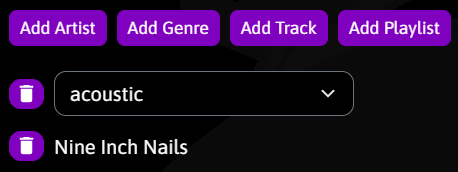
Seeds give the Spotify recommendations service an idea of what you're looking for. The service itself accepts at most five seeds, but MixMoose allows for more seeds and combines the results from multiple requests.
Track sources look for music similar to a song; artist sources start with a performer; genre sources start with a style of music. More sources broaden the starting points, but each run makes a bounded number of requests, so a very large source list may not be fully used.
When you provide a playlist seed, you have the choice to select between using its tracks or primary track artists. When generating a playlist, seeds from the playlists will be mixed with other seeds, though they will be less prioritized unless no other types of seeds were added.
Once a certain number of candidate tracks are retrieved or so many requests have been made, MixMoose will cease making requests from Spotify. That means if you provided 100 seeds there is a very high chance that not all will be used.
Exclusions
Tracks and artists included in exclusions will not get added to the generated playlist. If a playlist is excluded, the its tracks or primary track artist will be excluded depending on your selections. This is a great way to avoid duplicates if you have a lot of tracks.
Track Features
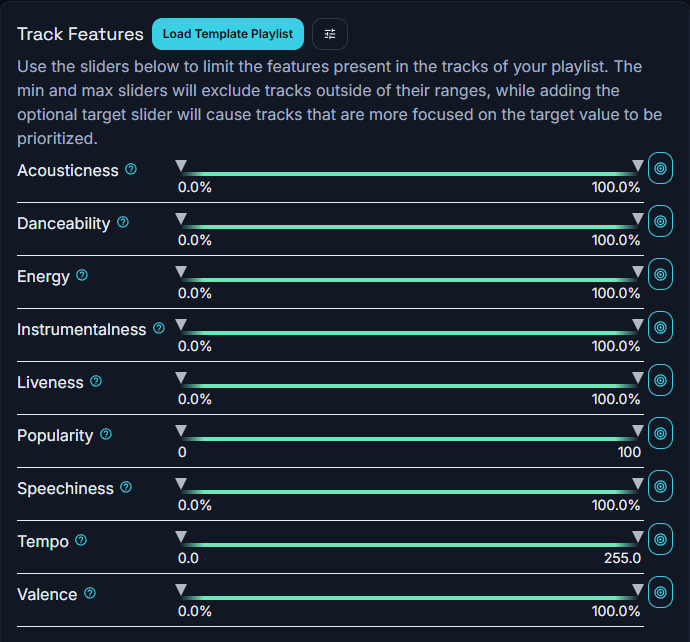
Track-feature ranges help focus the mix. For a more acoustic starting point, try an Acousticness minimum of 75%. Targets express a preference within a range. Restrictive combinations can leave too few results; widen them if generation fails.
Read what BPM, energy, and other audio features mean before choosing ranges.
The Load Template Playlist will set the range parameters to match the ranges of tracks on a playlist. Use this if you want to match the feeling of an existing playlist.
When Nothing is Found
Sometimes you'll see the message Unable to Create Playlist. Widening track features parameters can help, but fun fact - when MixMoose can't get any results, it tries widening the parameters with each additional request. The following are few reasons why this situation might occur:
- The Restrict Years parameter doesn't match the tracks being returned from the recommendations service. This might happen if you specify an artist from one era, but a year range from another. Maybe instead of specifying an artist, you could specify tracks from that artist's album that came out within your desired year range.
- If too great of a playlist length is given, then there might not be enough tracks that meet the given parameters. Try going a bit lower.
- If many feature range parameters are used and they are all very narrow, then that might create a situation where few tracks are returned from the recommendations service. You might have to give up on that very acoustic, EDM playlist.
Fun Surprises Ahead
Feel free to experiment with parameters while using the generator. A lot of times, crazy combinations can lead to disappointing results, but can also lead to great discoveries. If you're at a loss for inspiration, hit the Surprise Me! and have MixMoose generate an unique playlist for you.
If there are any ideas you want to see on the generator then please use the contact page for direct options, or send me a tweet with your latest creation.